

We’ve Seen This Before
Day 4 of 5

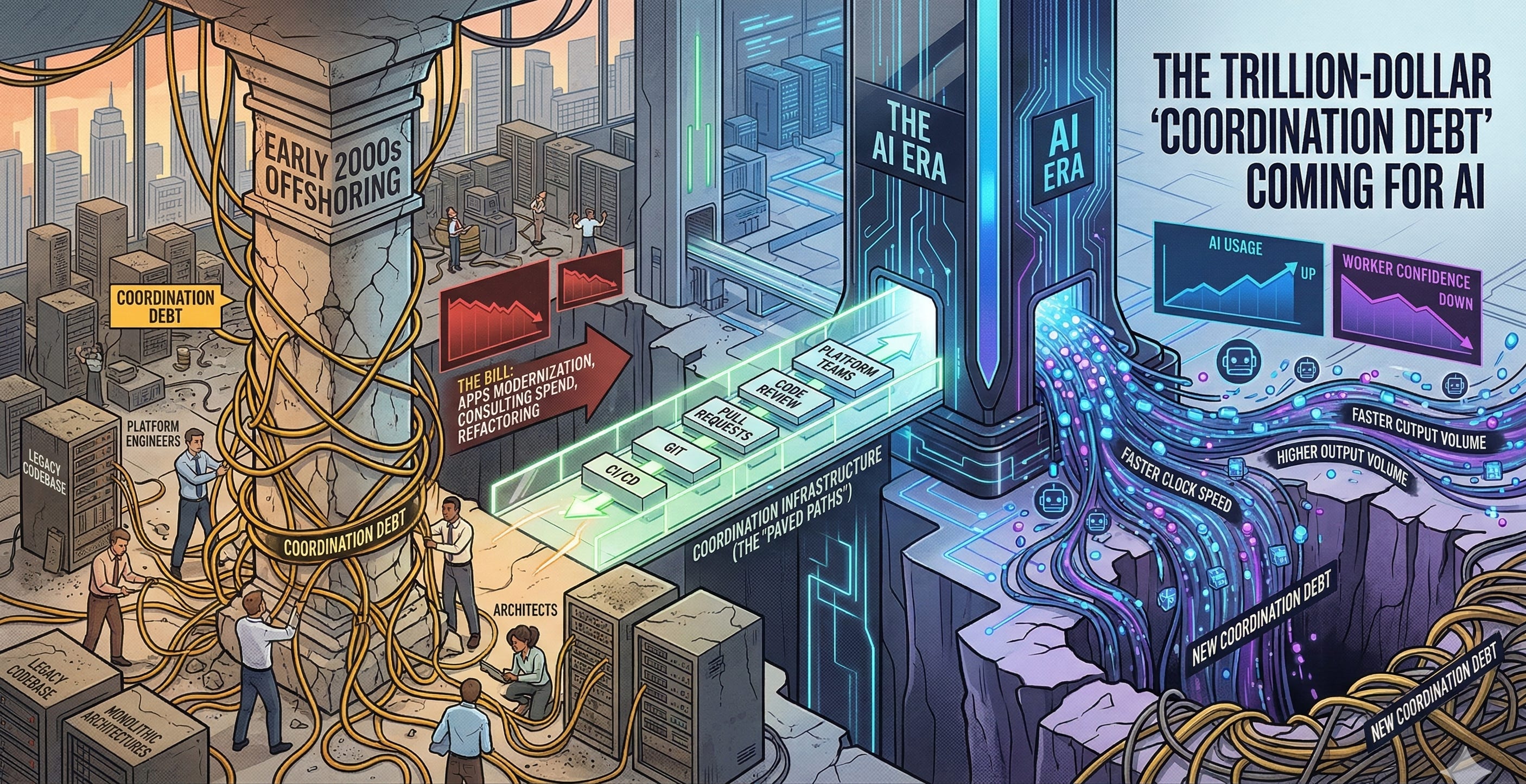
The early 2000s had a pitch that sounded a lot like today’s.
An engineer in Bangalore cost a fraction of one in San Francisco. The math was obvious. The future was obvious. American software development was finished.
What actually happened was messier. The hidden costs showed up fast: communication lag, context loss, rework cycles, the overhead of coordinating across time zones. Companies that wholesale offshored found themselves spending the savings on project managers, specification writers, and the slow accumulation of code that nobody onshore fully understood. Sound familiar?
Forrester’s January 2026 research found that nine out of ten firms attributing layoffs to AI had no mature AI application ready to fill the displaced roles. The parallel is exact. In the offshoring era, companies cut domestic headcount before the coordination infrastructure existed to make distributed work actually function. The same mistake is running again.
The industry didn’t revert. It didn’t go back to all-local teams. It found a hybrid equilibrium nobody predicted: onshore architects and product owners, offshore delivery and QA, async collaboration across time zones that actually worked. Not because the cost assumptions were wrong, but because the industry spent fifteen years building the coordination infrastructure to support them.
Git. Pull requests. Code review tooling. Continuous integration. These weren’t invented because developers liked process. They were invented because distributed work at scale required a shared record of what changed, why it changed, and who was responsible for it.
Here’s what that infrastructure looks like in 2026.
The cloud migration market is $300 billion this year and growing at 28% annually. Twenty years after the offshoring wave, enterprises are still paying to move the code that was written during that era into architectures that can actually be maintained. App modernization. Legacy refactoring. Cloud-native rewrites. The bill for the coordination debt of the 2000s is still being paid, and it runs into the trillions when you add up the consulting spend across two decades.
Platform engineering didn’t exist as a job title ten years ago. Gartner now predicts 80% of software engineering organizations will have a dedicated platform team by 2026, up from near zero in 2020. The entire discipline exists because distributed development at scale without shared infrastructure creates coordination chaos. Platform engineers build the paved paths, the golden paths, the internal developer platforms that make it possible for large teams to move fast without burning out the humans in the middle.
That job category was created by the offshoring era’s coordination debt. Hundreds of billions of dollars and two decades later, enterprises are still paying platform engineers to build the guardrails that should have existed from day one. Agents are about to create the same problem at a faster clock speed, with higher output volume, and with even less visibility into what was actually built.
The ManpowerGroup 2026 Global Talent Barometer captures where we are: AI usage up 13 percent, worker confidence down 18 percent. That gap is the 2004 moment of offshoring. The spend is real. The tooling to make it governable hasn’t been built yet.
The equilibrium exists. The industry will find it. The only question is whether it takes three years or fifteen — and how much coordination debt gets written in the meantime.
Tomorrow: what building the coordination infrastructure actually means this time.
Sources
Forrester, “AI And Automation Will Take 6% Of US Jobs By 2030”, January 2026
Cloud migration services market size, via Mordor Intelligence, 2025
Gartner platform engineering adoption forecast, via Microsoft Learn
ManpowerGroup 2026 Global Talent Barometer
Be Atomic covers the infrastructure, primitives, and ideas behind agent-native software development, written by the team building it. atomic.dev