

The Rework Nobody Counted
Part 2 of 5

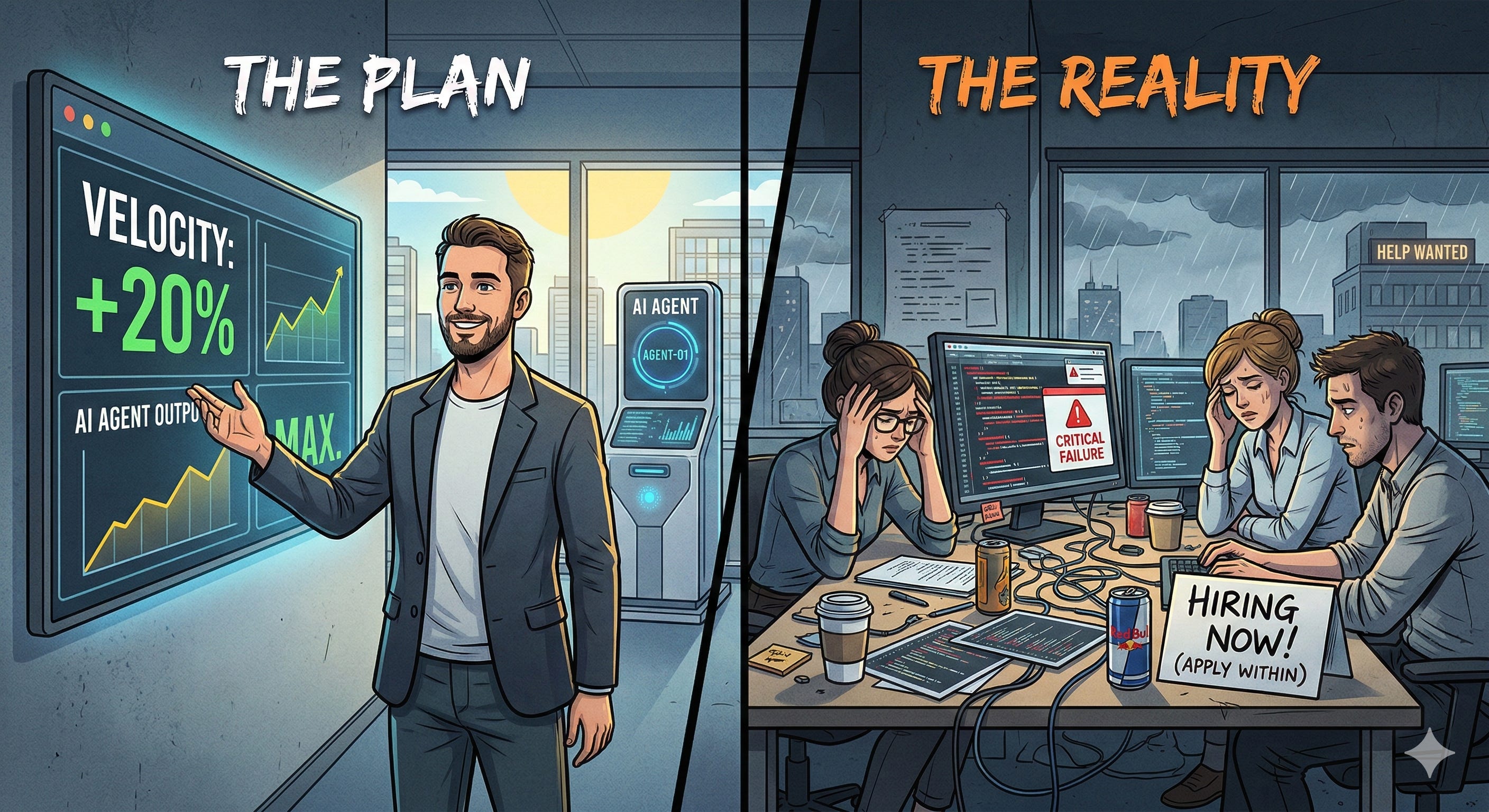
Yesterday we landed on a number: $750,000 a year per developer in tokens alone. Today we look at what that buys.
The benchmarks will tell you AI code completion rates are high. They won’t tell you what happens after the code ships.
CodeRabbit analyzed 470 open-source GitHub PRs and found AI-generated code produces 1.7x more issues than human-written code. Logic and correctness errors up 75%. Security vulnerabilities up 1.5 to 2x. GitClear analyzed 211 million lines of code and found a 41% higher churn rate on AI code — revised or thrown out within two weeks at nearly double the pre-AI baseline. METR studied 16 experienced developers on real production codebases and found they were 19% slower with AI tools than without. Those same developers believed they were 20% faster. GitHub’s own Copilot data shows only 30% of suggestions get accepted. 70% gets tossed.
Now do the math against Monday’s number.
If $750,000 a year is the token spend and 41% of that code gets rewritten within two weeks, roughly $307,000 of that spend is generating code that doesn’t survive contact with the codebase. Add the review overhead on the 70% of suggestions rejected before they ship, and the effective cost per unit of stable, production-grade code is dramatically higher than the token bill suggests. You’re not paying $750k for $750k of working software. You’re paying $750k for somewhere between $300k and $400k of working software, and spending the rest on rework, triage, and technical debt that will cost significantly more to unwind later.
Now layer in the pressure.
Executives watch output metrics — PRs merged, tickets closed, features shipped — and see numbers going up. So the mandate comes down: run more agents. This is working. Scale it.
The developers doing the reviewing are already at cognitive capacity. As we showed yesterday, a 10-agent workload means 10 simultaneous review queues and a context-switch cost that makes careful review functionally impossible. What actually happens is a rubber stamp dynamic. Developers approve PRs to survive the queue, not because the code is good. They know it needs another pass. They also know there are nine more items behind it.
UC Berkeley’s eight-month ethnographic study of 200 employees, published in Harvard Business Review, puts numbers on this. 83 percent said AI increased their workload. Burnout hit 62 percent of associates. Not because the agents weren’t producing output. Because someone had to check all of it, and that someone was already at capacity.
The developer cannot raise this in a status meeting. The entire justification for the last round of layoffs was AI productivity. Saying the agents need more oversight is career risk. So the rubber stamps keep flowing and the debt accumulates in silence.
Meanwhile, Citadel Securities, citing Indeed data, reports software engineer job postings are up 11% year over year as of early 2026, even as overall job postings are flat. Aaron Levie, CEO of Box, flagged this last week as proof that AI creates demand for engineers rather than destroying it. Companies see AI driving more output, start building things they never would have attempted before, and discover there are still 50 other tasks in software development that need humans.
He’s right about the pattern. The explanation is just less flattering than it sounds.
Agent-generated code with a 41% churn rate and 1.7x more issues per PR doesn’t reduce the engineering workload. It multiplies the surface area that needs reviewing, debugging, and maintaining. You don’t hire fewer engineers when your agents ship more problems. You hire more engineers to deal with them.
Demand for engineers is rising because AI is succeeding at generating volume, and volume at this quality level requires more human oversight, not less.
Tomorrow: when the CFO finally looks at the AWS bill and asks where the budget line is.
Sources
CodeRabbit, State of AI vs Human Code Generation Report, December 2025
GitClear, AI Copilot Code Quality 2025
METR, experienced developer productivity study, via Syntax.ai, July 2025
GitHub Copilot acceptance rate data, via NetCorp, Q1 2025
Ranganathan & Ye, “AI Doesn’t Reduce Work — It Intensifies It,” Harvard Business Review, February 2026
Citadel Securities, The 2026 Global Intelligence Crisis, citing Indeed job postings data, February 2026
Be Atomic covers the infrastructure, primitives, and ideas behind agent-native software development, written by the team building it. atomic.dev